
Making Digital Ads Simple, Affordable and Effective:
8 Things You Should Know About Digital Advertising for Your Business
The internet is a vast digital landscape traversed by millions every second of every day. So how do you sort through thousands of sites and apps to select the best place for your digital ads? It doesn’t need to be complicated or expensive and certainly shouldn’t suck time away from running your business. That’s why digital marketing companies exist, but business owners should still understand the basics of how the growing trend of digital advertising effects their business.
What is Digital Advertising? This is when you buy advertising space across websites, mobile apps, and social media p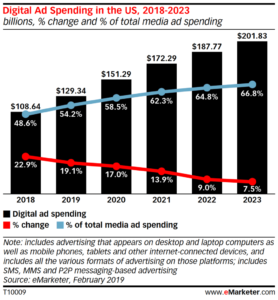 latforms where audiences are targeted with the help of specific information about their online behaviors, interests, and purchasing habits
For businesses wanting new customers, or an effective way to win back lost customers, digital advertising may be a needed addition to your marketing plan. Before jumping in with both feet, consider these eight suggestions (in no particular order) for the best chance of success.
1 – Your competitors are already doing it. Learn to do it better. 2019 was the first year that advertisers spent MORE money on digital than traditional advertising. Projections estimate digital ad spending to reach over $129 billion dollars this year.
A typical first step in to digital advertising is often on social media platforms like Facebook and Instagram because they make it pretty easy. Over 5 million small to medium sized businesses on Facebook spend money every month ADVERTISING TO SPECIFIC USERS. That doesn’t mean easy is right. There is a strategy to choosing demographics, working the algorithms and creating graphics that make the people you want to reach want to click. For the best return on investment, do your research or hire a pro.
2 – Make your advertising mobile. Choose strategies that work. We know businesses are spending money on mobile ads – we see them on our smart phones and tablets every day. Mobile Advertising, what we refer to as MOBILE CONQUESTING, is using location based, demographic, and behavioral targeting to reach consumers with digital ads (display and video) on their mobile devices (smartphones and tablets). The variety of targeting strategies available in mobile advertising offers the versatility and focus advertisers need. From specifically targeting competitor locations (geo-fencing) and promoting special events to people near your business (geo-targeting) to following devices to find similar consumers (geo-look a like) and running specific ads depending on the weather (weather trigger).
We can’t forget about the return on investment! Most mobile ad platforms offer reporting. To get the best “bang for your buck”, learn how to read those reports and make changes based on the results. For those of you with brick and mortar locations, more advanced options, like tracking mobile devices for in-store visits, can show you how many people actually walked into your store because they saw your mobile ad.
- Hyper-local advertising is all the rage. Be a part of your community. As online shopping continues to rise, so does the (opposite!) trend of shopping local. Hometown, small businesses need new customers now more than ever, but many miss the chance to reach the specific buyers they need. Hone in on a geographic audience, getting as specific as you can. You could start with targeting your ads to be shown only in certain zip codes. You could target a specific mile radius around your business, or your competitors. If you have a database of addresses, your digital ads can even be directed to show in their home on a variety of smart devices. Focus on your local area, that’s one of the biggest benefits of digital marketing. Then, as you grow, you can expand your targeting area using tested strategies that work. Focus on your community, on your neighborhood, and in only the areas that matter for your business. Don’t pay for more than you need.
- Trackable metrics provide valuable insight to evaluate results. With digital advertising, you have access to so much data. It just depends on what you want to see. For starters, Google Analytics is a great (free!) tool you can install on your website. It’s straight forward there are free classes to help you install and learn the basics.
View-throughs are a great example. That’s when someone sees your ad online, they don’t click on it, but venture to your site from another avenue. They may see the ad and come to your site later, or they may just open up a new tab on their browser so they don’t lose their spot. Either way, that’s trackable conversion and conversion – getting someone to do what you want them to do when they come to your website – is key. Do you want them to fill out a contact form? Apply for financing? Start a live chat with an agent? Tracking conversions tells you what people are doing when they come to your website after being served your ad so you can adjust your digital ads or website format to meet your goals.
If the thought of sorting through impressions, clicks, conversions, and view through reports is just too overwhelming, digital marketing companies (find one locally owned in your area) provide easy to understand monthly reports and the guidance for your next step. For certain digital products, companies like Moxii Marketing Solutions are able to provide reports on website/app breakout, creative p erformance, device performance, and top keywords to maximize your marketing efforts.
- Video is good, but not if it’s bad. Critique your work. 80% of internet users can remember a video ad they have seen in the last 30 days and 90% of consumers say video helps them make a decision to buy. With apps like Ripl and Legend, making video ads has become a lot easier, especially for the small to medium size business that can’t pay outrageous production fees. Some of the best performing video ads are “homemade” video ads shot on smartphones because they were branded, creative and engaging. Video can be King, as long as it’s a good video. If it’s poor quality, random content or (dare we day) boring, it’s better to stick to stock graphics and posts/stories your more comfortable creating.
- Broaden your horizons. Add new technology to your marketing plan. Digital marketing is more than a few boosted posts on social media or a commercial on your local station. Digital advertising has is the ability to coordinate ad campaigns across multiple online platforms and products at the same time. Strategies like retargeting (ads that follow you to different web sites) and geo-fencing (targeting mobile devices in a specific geographic location) are becoming more familiar, but new strategies continue to develop. One of the newest forms of digital advertising available is OTT or “Over The Top” video advertising on streaming devices. Now, small businesses can afford to target “cord cutters” by serving ads in home on Roku, Slingbox, Smart TVs and more as well as on mobile devices with TV apps like Fox and CBS. There are 168.1 million people watching content through apps and streaming services. That’s a lot of people that you can advertise to directly that you might miss if you are only utilizing more “traditional” advertising options.
- Understand the costs. Some are obvious, some (like your peace of mind) are not. We all have marketing budgets. It keeps many small business owners up at night as they try to figure out the best way to spend those precious dollars and where they’ll find the time to make it happen. Digital Advertising can streamline the process and provide insights on your investment. With services starting as low as a penny per impression, digital ads can be purchased by any company. Here’s the kicker… digital ads target a much more specific audience of users: Those most likely to be interested in your product or service. There is so much data out there so businesses like yours can effectively target a specific audience. Some companies will have a Digital Buyer or hire a marketing company to do the ad buying for them. This accomplishes a few things. One, it cuts down the amount of time you need to spend researching how to accomplish everything on your wish list. Second, it allows business owners to focus on running the business, not coordinating a multi-platform ad campaign. Lastly, it provides detailed reporting on how well your campaign is performing so you can protect your long-term bottom line.
- It can be easy to understand.Find an expert you can trust. The key here is to find an expert to explain the ins-and-outs of digital ads, and keep you up-to-date on emerging tech. That could be a radio, newspaper or TV station sales rep, or a local ad agency. It’s their job to know the business and should be able to break it down in a clear manner that allows clients to easily grasp the process, cost and estimated results. Just because you don’t live in the world of digital advertising doesn’t mean it’s too complicated for to understand. It’s not. Just find yourself the right partner to explain it to you, a partner that you trust, a partner that is truly interested in helping your company grow. Not just taking your money for a few months.
Digital advertising is growing. More and more businesses are spending more and more money because, well, it works. We are all spending more time online, which means advertisers have more opportunity to reach a specific target audience as they browse on their favorite device. Invest in yourself. Invest in your company. Invest in Digital Advertising. It has become a must have piece of your marketing tool kit.
